
My process as a holistic herbalist is inspired by a philosophy known as Vitalism. This doctrine of heath recognizes an external vital force as the source of life. This vital force is what fills us and all of life with energy, a heartbeat, and movement. Vitality opposes the signals of death and so this vital force is what gives potency, vibrancy, and essence to the duration of a life. Vitality can ebb and flow throughout a lifetime, it is variable in quality. Not all herbalism operates through this perspective and not all herbalism is practiced holistically.
The dominant way of approaching herbs is perceived through an allopathic model, where you reach for peppermint to treat a headache. Simply, herbalism is overwhelmingly prescriptive as if one remedy works for all humans the same. For some, peppermint eliminates a headache while for others it aggravates.
Natural medicines of the Earth are not purely pharmacological like pharmaceutical drugs… remedies of the Earth are spiritual in nature and this is what gives them their unique powers to heal in a whole, harmonious way.
As a Vitalist herbalist I look at the energetic profiles of plants first and foremost which tell me so much about their application. Some very useful energetic elements of plants are exemplified in their physical form… such as color, smell, taste, morphology, companions, and habitat. A plant’s more esoteric energetics and application can be extrapolated not only through symbolic interpretation of a physical quality but also through planetary correspondence.
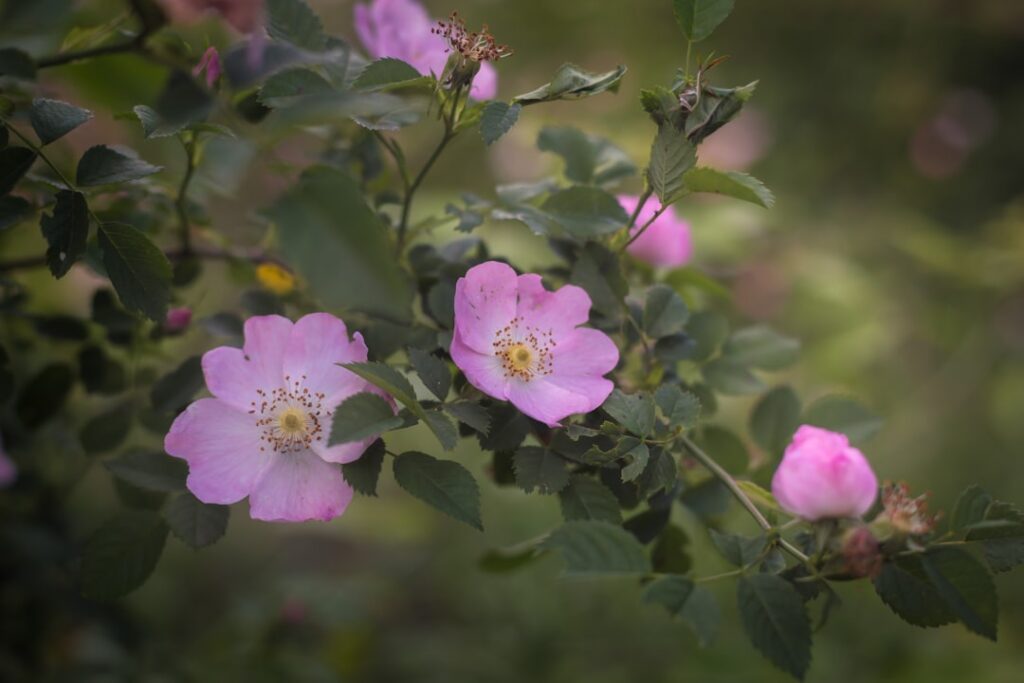
A wonderful example: Rose (ruled by Venus) thrives in an environment of protective thorns. The flowers are delicate, subtle, and beautiful (Venus) which bloom among its ironically thorny branches, showing that rose will have an influence on challenging relationship dynamics either internal or interpersonal. This is why rose is so widely renowned as a heart medicine and known as a symbol of love, especially tumultuous love.
Since I am based in the interior mountains of British Columbia, I will get even more specific when discussing rose. The wild rose most abundant in this region is known as baldhip rose (Rosa gymnocarpa) – this is the rose that sprawls along roadside and yields delicious seed pods known as rose hips (hypanthium) in the fall after the first deep frost.
As stated above, rose’s spiritual correspondences are fairly obvious to draw and these correspondences are bolstered by its energetics. While each species has its unique appearances and qualities, the wild species found here in the Pacific Northwest have interchangeable medicinal applications.
Rose shows its energetics through its taste (sour), tone (astringent) – which is also a mouth feel, extension of the taste, and temperature (cooling). A plant with this profile is then applied to a hot, inflamed, loose tissue state like a sinus cold that oscillates between very stuffy & uncontrollably runny. Rose will tighten smooth tissues making it a key remedy for inflamed gums that are prone to bleeding, or applied in bouts of discharge or diarrhea.
This is an example of how a plant’s signature energetics can be applied for acute and specific symptomatic patterns. Here we can see why plants become either ineffective or harmful for individuals when reached for with the allopathic, prescriptive thinking of “use this (universally) for that”.
Holistic application of a plant requires assessment of its total energetics to ultimately discover an individual’s specific medicine… a remedy that can shift and transform a pattern at the root.
My practice is one of pattern recognition and requires acknowledgment of an individual’s entire story, past – present – future. To me, an amazing aspect of the plant kingdom is how plants are bridges between the physical and the spiritual realms. When chosen properly, their medicinal power acts on all layers of being, seen and unseen. Studying the vital nature of plants reveals patterns embedded in all of Life, patterns which will help guide you to a more complete, more whole expression of your self as a unique thread in the greater web. Everything is connected.
Going a bit deeper. The foundation of herbal remedy selection for the Western physiomedicalists often utilized assessment of the qualities of temperature, moisture, and tone of a particular tissue state or symptomatic pattern. This is known as tissue state energetics and is one of the keys to assigning the proper remedy which will ultimately encourage the vital energy in an individual towards self-correction and regulation. Plants have their own energetic profiles and can be used either through sympathetic or antipathetic application, and there are often contradictory aspects of each quality in one single herb. This is essentially the understanding of how a plant’s energetic qualities can mirror its environment and/or exemplify as the opposing antidote to its environment.
Sympathetic correspondence, as an example, can be seen in how horsetail likes to grow in damp, shady environments (like a shaded ditch) and is a very powerful diuretic, acting on the water element within the body both through diuresis and mineralization. One wonderful example of an antipathetic remedy is plantain, which can usually be found growing abundant in patches of dry, rocky dirt or newly disturbed and exposed land. Plantain is a powerful moistening demulcent for the digestive system, as well as a quick home remedy for burns.
These qualities of sympathy and antipathy can be used simultaneously, and often should be, to determine the proper remedy for the underlying tissue state driving the symptoms.
In terms of temperature, moisture, and tone there are 6 tissue states critical to consider when choosing a proper, constitutionally balanced remedy. These tissue states are the key to differentiating between remedies that are otherwise all positioned together by action as is the case in most herbal reference books. Using an herb simply based on its herbal action is what drives the allopathic model of herbalism I’ve chatted about, take this herb because it has an herbal action that addresses the symptom.
The 6 tissue states are all determined within the confines of the three categories mentioned above. Temperature can be assessed as hot or cold; moisture is determined as damp or dry; tone is defined as relaxed or tense. By asking yourself about these three qualities and the opposing duality present within them, you can find a more precise remedy by recognizing the state of the tissue rather than simply applying an herb based on its herbal action, which can often times be contraindicated for your constitution.
To implement this requires recognition of the vital standard of the individual (their constitution), as well as the vital properties of the potential plant remedies for the tissue state(s) at hand. The combination of these two aspects, while also considering the greater holistic picture of the person’s life, is what guides a Vitalist Herbalist on the path of suggesting someone’s specific medicine; applying a specific medicine ultimately acts as an energetic and physical catalyst to encourage the entire being to establish self-regulation once more. This is a healing process made possible because you and your environment are interdependent, interconnected, and always in communication.
More Journals
The Heart is Your Tether | Vital Roots 003
01/06/2026
My service to women is fundamentally guided by a profound interest in medicinal plants.